Anxious attachment: signs, where it comes from, and how to calm down in a relationship
Anxious attachment is a style in which, in a relationship, you are afraid of being left: you check often, you read meaning into every silence, and you need to hear that everything is okay. It comes from your first relationships, but it is not a life sentence. It changes when you learn to calm your own alarm and to ask directly for what you need.
Below is what this style means, how to recognize it, what happens when an anxious person loves an avoidant one, and what helps.
What anxious attachment is
Attachment theory goes back to psychiatrist John Bowlby and to psychologist Mary Ainsworth's studies of how young children react when a parent leaves and comes back. In 1987, psychologists Cindy Hazan and Phillip Shaver showed that adults bring similar patterns into romantic love.
People usually talk about four styles: secure, anxious, avoidant and anxious-avoidant (also called disorganized or fearful). A style is a tendency, not a lifelong label. Many people have a mix, and a style can change through good relationships and work on yourself.
With anxious attachment, closeness is wanted very much and always seems about to disappear. The alarm system is set to sensitive: a late text sounds like danger.
Signs of anxious attachment
You do not need all of them. What matters is how often they show up and how much they drain you.
- You check your phone when your partner does not reply and imagine reasons.
- A short or cold message ruins your whole day.
- You often need to hear that things are fine between you.
- After a fight you cannot calm down until everything is fixed.
- You worry that if you state your needs you will be "too much".
- You stay in relationships that are not good for you because you are afraid of being alone.
A late text is not danger. Your alarm just sounds like it is.
Anxious and avoidant: the loop many couples get stuck in
People with anxious and avoidant attachment are often drawn to each other. The first seeks closeness when they feel unsure. The second needs space when closeness gets too much. The more one moves closer, the more the other pulls back, and the pulling back makes the first even more anxious.
Nobody is to blame in this loop: each person is doing what once kept them safe. The loop breaks when at least one of them notices what is happening and says it out loud, without blame.
What helps
The goal is to be able to calm yourself too, without waiting for your partner to confirm that everything is fine.
- Name the alarm. "I am scared right now that they are pulling away." Said in your head or written down, the fear loses some of its force.
- Wait before the second text. Give yourself an hour. Most of the time the reply arrives in the meantime, and the reason is ordinary.
- Ask directly. "I need us to talk for ten minutes tonight" works better than testing whether your partner figures it out alone.
- Build a life outside the relationship too. Friends, projects, time that is only yours. The more the relationship is the only place you feel good, the louder the alarm gets.
- Choose consistent people. A partner who does what they say calms your alarm more than any technique.
- Consider therapy. Attachment responds very well to work with a psychologist, especially when it comes from hard experiences.
The fear does not disappear. The time it holds you gets shorter: an evening instead of a weekend, an hour instead of an evening.
When it is more than a style
If fear of being left takes up most of your day, if you have panic attacks, or if you stay in a relationship where you get hurt, talk to a psychologist. If someone hits or threatens you, call your local emergency number. In the US, the National Domestic Violence Hotline is 1-800-799-7233.
How Kibo helps
Kibo is an AI mentor that remembers what you tell it about your relationships. You can add your partner or other people who matter, and Kibo tells you how the two of you work together, what holds you together and what to watch for. It notices what sets off your alarm and gives you one small step a day.
It is free to use. It is not couples therapy and it does not diagnose. It helps you see your pattern on ordinary days.
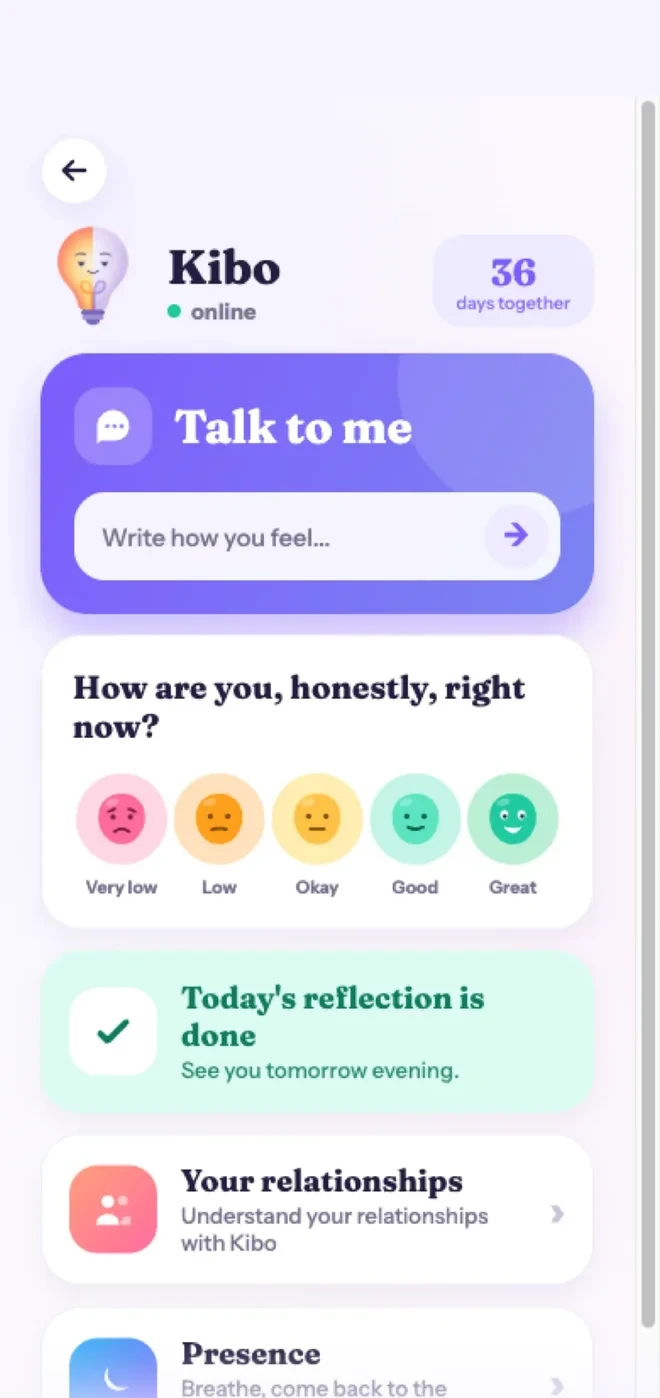
If you want something that remembers what happens in your relationships, Kibo is free to download and starts without an account.
Get KiboFrequently asked questions
Can anxious attachment be healed?
It is not an illness, so it is not healed, but it changes. With stable relationships, practice and often therapy, many people reach what psychologists call earned secure attachment: the fear still shows up, but it holds you less.
How do I know my attachment style?
One clue is how you react when your partner pulls away: if you get agitated and look for reassurance, you lean anxious; if you withdraw and need space, you lean avoidant. Online quizzes give you an idea, but a psychologist can do a real assessment.
What is anxious-avoidant attachment?
The term is used in two ways. Sometimes it means a couple made of an anxious person and an avoidant one, stuck in a loop of chasing and withdrawing. Other times it means a style in which one person wants closeness and fears it at the same time, also called disorganized or fearful attachment.
Does anxious attachment mean I am too dependent?
Not necessarily. Needing closeness is normal. The problem starts when your calm depends almost entirely on the other person's reactions. The goal is to be able to calm yourself too. The love you need stays the same.