People pleaser: why you say yes when you want to say no
A people pleaser keeps putting their own needs last to keep others happy and avoid conflict. It is not a diagnosis. It is a learned pattern, usually learned early, and it changes through small steps: you notice the moment you say yes automatically, you buy time before you answer, and you practice small no's with safe people.
Below are the signs, where the pattern comes from, what it costs you, and the steps, in the order that works best.
Signs of a people pleaser
If more than half of these sound like you, the pattern is yours.
- You say yes on the spot and regret it five minutes later.
- You apologize for things that are not your fault.
- You feel it is your job to make sure everyone is okay.
- You avoid any conflict, even a small and necessary one.
- When someone asks what you want, you do not know what to say.
- You wear yourself out for others, then get angry in silence.
Where it comes from
Most of the time, the pattern is learned in childhood. If peace or affection at home depended on how good and easy you were, you learned that pleasing others keeps you safe. The strategy worked back then. The trouble is that you carry it into places where you no longer need it.
Therapist Pete Walker called this response "fawn", a fourth stress response next to fight, flight and freeze: when you feel threatened, you try to appease the other person. In a people pleaser, it fires even when the "threat" is just someone's disappointment.
You learned early that pleasing people kept you safe. Now it costs more than it protects.
What it costs you
Exhaustion comes first. When you say yes to everything, your day fills with other people's priorities. Resentment comes next: you end up angry at people who do not even know they asked too much, because you never told them.
The third cost is harder to see. The people around you know a version of you that always agrees. The relationships look fine, but nobody knows what you want, sometimes not even you.
How to get out of the pattern
The order matters: start with what is easy and work up.
- Buy time. Instead of an instant yes, say "Let me get back to you in ten minutes" or "I will check my calendar". The pause lets you ask yourself whether you want to.
- Start with small no's, with safe people. A colleague asking for a pen, a friend suggesting a film. Practice where the stakes are low.
- Say no without an essay. "I can't this time" is a complete sentence. The more you explain, the more negotiable it sounds.
- Let the guilt be there. The guilt after a no shows that you are doing something new. Get through it without changing your mind, and it shrinks every time.
- Ask what you want before you ask what they want. At first you will not know. That is normal, it is a muscle you have not used.
Every evening, write down how many times you said yes when you meant no. Just that, without changing anything. By the end of the week you will see for yourself with whom, and in which situations, it happens.
People pleasing in a relationship
In a couple it looks like this: you always pick their restaurant, their film, their friends, and one day you explode over something small. Your partner does not understand, because from their side everything was fine.
The first step here is to state a small preference, often. "Today I would like us to pick the place together" is easier than a big talk about needs, and it teaches the relationship that you get to want things too. If the pattern comes with a fear of being left, read our piece on anxious attachment as well.
How Kibo helps
Kibo is an AI mentor that remembers what you tell it. When you say yes to everything, it spots the pattern in the situations you describe, shows you with whom it happens, and gives you one small step a day, like a small, safe no. The next day it asks how it went.
You can add the people in your life, and Kibo tells you how the two of you work together. It is free to use. It is not therapy. It is daily training for a muscle you have not used.
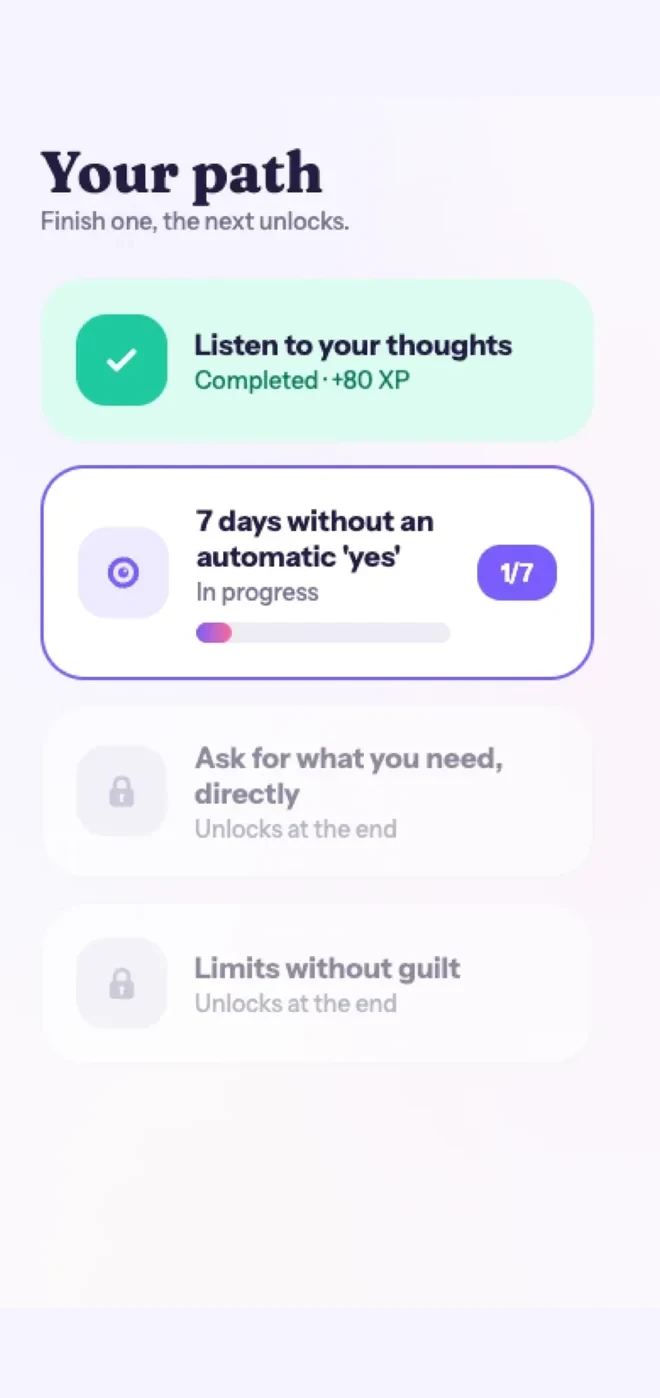
If you want something that shows you the pattern and gives you one small step a day, Kibo is free to download and starts without an account.
Get KiboFrequently asked questions
Is being a people pleaser bad?
Being kind is not bad. It becomes a problem when you say yes out of fear, and when it costs you sleep, time or relationships. Then it is worth working on, in small steps.
How do I say no without feeling guilty?
At first you will not manage it. The guilt shows up because you are doing something new. Say a short no without long explanations, and let the guilt pass without changing your mind. It shrinks every time.
What is the difference between empathy and people pleasing?
Empathy means understanding what the other person feels. People pleasing means feeling responsible for changing how they feel, even at the cost of your own needs. You can understand someone and still tell them no.
Can a people pleaser change?
Yes. It is a learned pattern, so it can be unlearned. It works best with small, repeated steps: a pause before answering, small no's, preferences stated often. A therapist helps a lot if the pattern comes from hard experiences.