How Much Does Therapy Cost and What to Do If You Cannot Afford It
You decided you want to talk to a therapist. You looked up prices, did quick monthly math and closed the tab. If that sounds familiar, you are not alone and you are not cheap. Therapy is a serious investment, and for a lot of people it simply does not fit the budget right now.
The good news is that the right question is not just how much a therapy session costs. The right question is what options exist at every budget level, from classic weekly therapy down to far more affordable alternatives that keep you moving until you can afford more.
In this article you will find realistic price ranges, the reasons therapy costs what it does, the cheaper options that already exist, and an honest look at where an AI psychologist like Kibo fits into the picture. No inflated promises, no made up numbers.
How much a therapy session actually costs
In the United States, an individual therapy session typically costs $100 to $250. In large cities and with highly experienced therapists you will often see rates at the top of that range or above it. Newer therapists, smaller towns and community settings usually come in lower. In the UK and much of Europe the pattern is similar even if the numbers differ: big city and deep experience mean higher rates.
Couples therapy is almost always more expensive than individual work. Sessions tend to run longer and the work is more complex, so expect rates noticeably above a standard individual session.
What really scares people is not the price of one session but the rhythm. Therapy works best with weekly sessions, at least in the beginning. That means four sessions a month, so roughly $400 to $1000 monthly at typical rates. For many budgets, that number is simply out of reach right now.
One honest caveat: prices vary a lot by country, city, credentials and type of therapy. Treat these figures as orientation, not an official rate card. Most therapists list their fees openly, so the safest move is to ask directly.
Four sessions a month at typical rates adds up to roughly $400 to $1000. By comparison, Kibo is free to use, and Kibo Pro costs far less than one session.
Why therapy is so expensive
When you see the price, it is easy to think you are paying for an hour of conversation. In reality you are paying for far more than that hour. A licensed therapist went through years of university, a clinical degree and a long, expensive training program. Many also completed mandatory personal therapy as part of that training.
Then there is supervision. Serious therapists pay an experienced supervisor on an ongoing basis to review their cases and keep their work ethical and sharp. That is a recurring cost baked into the fee, and it directly protects the quality of what you receive.
Add the running costs: office rent, insurance, taxes, continuing education. And one detail few people consider: a therapist cannot see clients eight hours a day. The work is emotionally intense, so a limited number of weekly sessions has to cover all of those costs.
The takeaway is not that the price is unfair. The takeaway is that the price has real reasons behind it, and if you cannot afford it right now, the answer is not to wait passively but to use the more accessible options that exist.
You are not paying for an hour of talk but for years of training.
More affordable options when money is tight
If full price therapy is not an option right now, you have several real paths, not just theoretical ones. Each comes with tradeoffs, but all of them beat postponing your mental health entirely.
Also worth knowing: many employers offer free counseling sessions through employee assistance programs, and many health insurance plans cover therapy partially or fully. Ask HR or read your policy. A surprising number of people have this benefit and never use it.
- Therapists in training or under supervision: they work under the guidance of an experienced supervisor and charge significantly reduced rates, sometimes half or less. Quality can be excellent, because they are motivated and closely monitored.
- Sliding scale therapists: many therapists reserve spots at reduced fees based on your income. It never hurts to ask, the worst answer is no.
- Community mental health centers and nonprofits: they offer free or low cost counseling, especially for specific situations like grief, domestic violence or youth anxiety.
- University training clinics: psychology departments often run clinics where advanced students see clients at low rates, under strict supervision.
- Online therapy: it removes commuting and often comes at lower rates than an office visit. Research shows it works comparably to in person therapy for many common problems.
Where an AI psychologist like Kibo fits in
Let us be honest from the start: an AI psychologist does not replace psychotherapy. A human therapist notices what you do not say, works with trauma, holds you accountable inside a real relationship. No app does that, and no serious app should claim it does.
What an AI psychologist can do is different, and valuable in a different way. Kibo builds a psychological profile from your answers, then walks with you daily: a guided evening reflection on how your day went, a morning insight with one concrete action matched to your level, and a portrait of you that keeps rewriting itself as it learns. And when you have a rough night at 11:40pm, you can simply open the chat and talk.
The economics are the striking part. Kibo has a free version you can use every day, and Kibo Pro costs far less than one classic therapy session. You get company every single day, instead of 60 minutes every other week when the budget allows. It is not the same work as therapy, but it is real work, done consistently.
That is why Kibo works so well as a bridge. A bridge until you can afford therapy: you arrive at your first session already carrying a vocabulary about yourself, observed patterns, a written history. Or a bridge between sessions, if you see your therapist less often than you would like: what you uncover in the room gets practiced daily instead of fading by the next appointment.
And because this is intimate territory: you can start Kibo in guest mode without handing over personal data, and your conversations are encrypted. The free version shows you whether it fits before you pay anything.
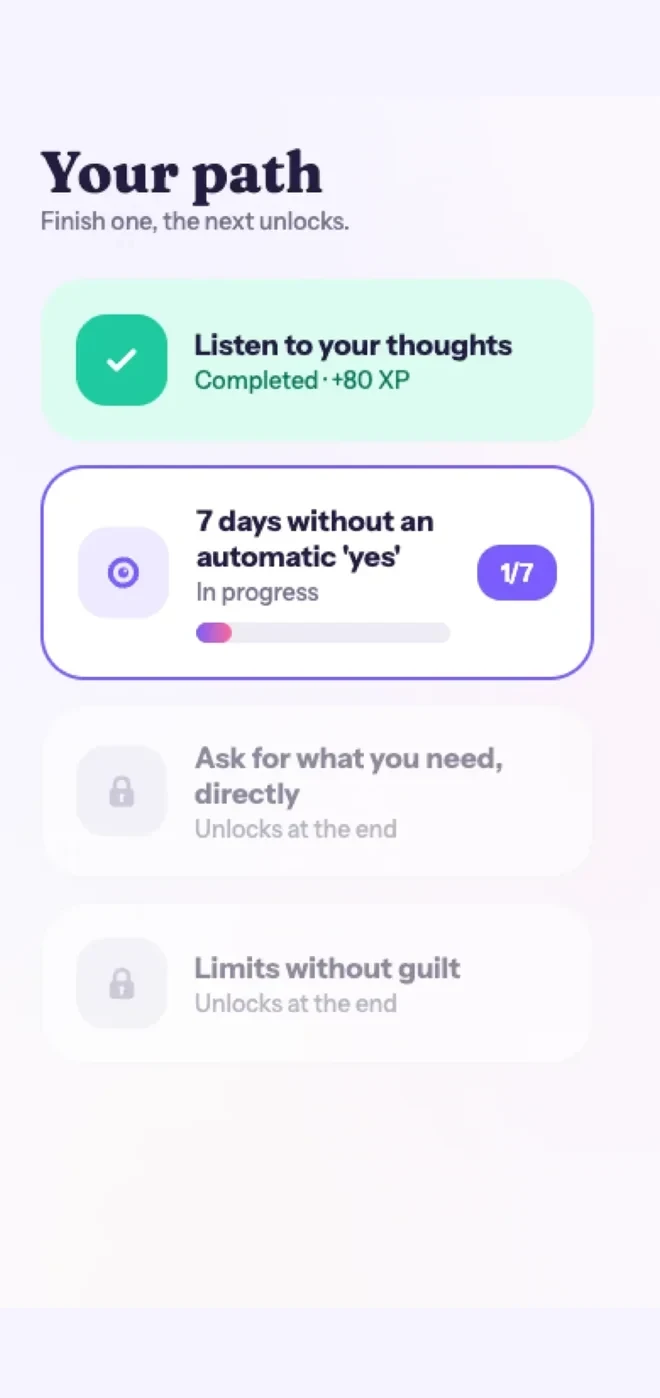
The combination that works best: therapy plus daily practice
If you can afford at least some therapy, the best setup is not therapy or an app. It is therapy and daily practice together. Your therapist gives you depth: working with the past, with relationships, with what is hard to see alone. Daily practice gives you continuity: the habit of observing yourself, naming what you feel, taking one small step every day.
Many people go to therapy every other week or once a month precisely because of cost. In that setup, a daily practice tool fills the gap between sessions: you note in the evening what happened, and at your next session you do not spend 20 minutes reconstructing the past two weeks from memory.
Think of it like the gym and a personal trainer. The trainer corrects your form and builds your plan, but the real progress comes from the workouts you do on your own between sessions. The mind works the same way: change comes from daily repetition, not only from the hour spent in the office.
Real progress happens between sessions, in the small steps you repeat every day.
What to do today, whatever your budget
If you can afford weekly therapy, find a therapist and book the first session. It is the most direct investment in yourself, and nothing in this article argues against it.
If money is tight, pick one of the affordable routes: a supervised therapist, a sliding scale spot, a community clinic or online therapy. And if you want to start tonight, with no appointment and no financial risk, try an AI psychologist like Kibo: it is free to use, and Kibo Pro costs far less than a single session. It is not therapy, but it is a real start, and a real start beats a perfect plan you keep postponing.
One thing is not negotiable: if you are in crisis or having thoughts of harming yourself, do not wait for therapy or for any app. In the US, call or text 988. Elsewhere, contact your local emergency number or crisis line. Trained people are available right now.
Get Kibo and see what it feels like when something actually listens.
Get KiboFrequently asked questions
How much does therapy cost per month?
At the recommended rhythm of one session per week and typical rates, therapy usually lands between $400 and $1000 per month in the US. You can lower that with a sliding scale therapist, online therapy, or a biweekly rhythm supported by daily practice.
Is there free therapy available?
Yes, though spots are limited. Community mental health centers and nonprofits offer free or low cost counseling, university clinics charge symbolic fees, and many employers cover sessions through assistance programs. In a crisis, call or text 988 in the US, free and available around the clock.
Is online therapy worth it?
For many problems, yes. Research shows results comparable to in person therapy for anxiety, mild to moderate depression and stress. It is often cheaper and removes the commute. The fit with your therapist matters more than the format.
Can an AI psychologist replace therapy?
No, and it should not claim to. An AI psychologist like Kibo is a tool for self knowledge and daily practice: evening reflection, morning insight, a psychological portrait that keeps updating. It is an excellent bridge until therapy or between sessions, not a replacement for a human therapist.