Is it safe to talk to an AI about how you feel?
You want to try an AI companion for your mental health, but something holds you back. It is not laziness. It is a very healthy question: is it safe to write to a program about the most private things in my life?
The short answer: it depends on the app. Some are built seriously, with encryption, clear rules and a crisis protocol. Others treat your thoughts like any other piece of marketing data.
This article walks you through the real risks, the questions to ask before you type your first message, and what a good answer to each one looks like. So you can decide with information, not blind trust.
Why this question is legitimate
When you talk about how you feel, you are not handing over a password or a card number. You are handing over something much harder to replace: your fears, your relationships, the things you are ashamed of. A password takes 30 seconds to change. What you said about your marriage cannot be taken back.
On top of that, a human therapist works under an ethics code, a licensing board and legal liability for confidentiality. An app only has the privacy policy it wrote for itself. Which is exactly why it is worth reading, or at least knowing what to look for in it.
So no, you are not paranoid. You are exactly as careful as anyone should be with mental health data. The question is not whether to be cautious, but what to be cautious about.
Risk 1: where your data ends up
The first real risk is the path your data takes. When you write in a chat about your anxiety, that message leaves your phone, lands on a server, passes through an AI model and gets stored somewhere. At every step there is one question: who has access?
Here are the scenarios to avoid. Some apps sell aggregated data to advertising partners. Some use your conversations to train AI models, which means fragments of what you wrote can shape answers given to other people. Some simply do not encrypt anything, so one security breach and your emotional journal is public.
The good signs look like this: sensitive data is encrypted in transit and at rest, the policy explicitly says it is never sold or used for ads, and you can see and delete everything the app knows about you, any time, without begging a support team.
One more good sign is the option to start anonymously. If an app lets you use it without an email, as a guest, it is telling you that trust should be earned, not demanded up front.
Every message about your feelings passes through servers, the question is who has access.
Risk 2: the quality of the answers
The second risk is more subtle and less discussed: not what happens to your data, but what the AI says back. A generic AI model is trained to be pleasant. And pleasant is not the same as helpful.
The first trap is excessive validation. You say you want to quit your job on an impulse, and it tells you that you are brave and should listen to yourself. Sounds nice, but a real therapist would have asked what happened today that made you decide this now.
The second trap is generic advice. Breathe deeply, take a walk, write in a journal. None of it is wrong, but it is the same for everyone. If the app does not build a psychological profile of you over time, you get horoscope answers: vague enough to feel like they fit.
The third trap is the serious one: no crisis protocol. If you tell an AI you do not want to live anymore and it keeps chatting as if you had asked for a recipe, that app should not exist. A responsible system recognizes the moment, stops the chat and points you to immediate human help.
Questions to ask any app before your first message
You do not need to be a lawyer to vet an app. Look through the privacy page and the product description for the answers to a few simple questions. If you cannot find them within 5 minutes, that is already an answer.
- Is my data encrypted, both in transit and where it is stored?
- Is my data sold or used for advertising? Look for an explicit NO, not vague wording.
- Are AI models trained on my conversations? If so, can I opt out?
- Can I see everything the app knows about me and delete all of it, permanently, from inside the app?
- Can I try it without giving an email or phone number?
- Does it have crisis detection? What exactly happens if I write that I want to hurt myself?
- Who is behind the app? A team with names and a contact address, or an anonymous website?
Check in 5 minutes: encryption, an explicit NO to selling data and ads, full deletion from inside the app, a guest mode and a crisis protocol. If you cannot find the answers, that is already an answer.
How Kibo handles this, concretely
We built Kibo starting from exactly that checklist, because we would not use an app that fails it ourselves. Here are our answers, point by point.
Sensitive data is encrypted at rest, it is never sold, and no advertising is built on it. There is no scenario where what you write in your evening reflection ends up with an advertiser. The business model is simple and transparent: Kibo is free to use, and people who want more pay for Kibo Pro. You pay for the service, you are not the product.
You stay in control: you can open the psychological profile Kibo has built about you at any time, and you can delete everything, straight from the app. And if you do not want to expose anything at first, there is guest mode: you start without an email and see how it works before sharing any data at all.
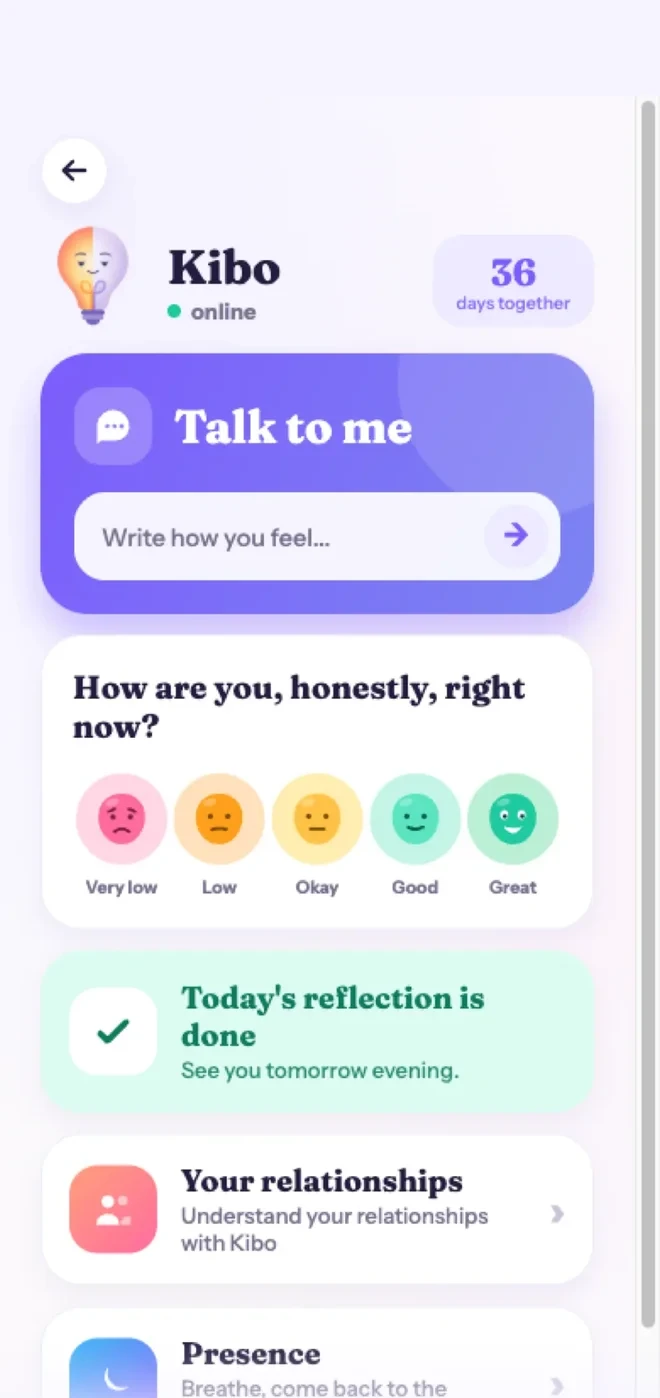
On the quality side, Kibo does not give horoscope answers because it does not answer in a vacuum. It learns from your evening reflection, rewrites its portrait of you every day, and gives you one insight with one concrete action, matched to your situation, not to some generic person. If you are a people-pleaser, you get something different from someone fighting perfectionism.
Most important of all: Kibo has crisis detection. If the chat shows signs that you are in danger, the conversation stops and you are directed to real help: in the US, call or text 988 (Suicide and Crisis Lifeline), or call 911 in an emergency; elsewhere, use your local emergency number and crisis line. An AI has no business handling those moments, and we say so directly in the product. It does not diagnose and does not replace a psychiatrist or a licensed therapist.
What you should never do with an AI
However good the app is, two limits are non-negotiable. First: never use an AI in a crisis. If you have thoughts of harming yourself, if you are in danger, or if someone near you is, contact 988 or 911 in the US, or your local emergency services. Now, not after one more message.
Second: never ask an AI for medication decisions or a diagnosis. If you are on psychiatric treatment, any adjustment belongs in a conversation with the doctor who knows you and your history. An AI must never tell you to increase, lower or stop a medication, and if it does, close the app.
Used correctly, an AI companion is a tool for the space between sessions and between crises: understanding your patterns, daily reflection, small consistent steps. That is what it is built for, and that is where it earns its place.
In a crisis, do not use an AI. In the US, call or text 988, or call 911 in an emergency.
So, is it safe?
It can be, if you choose with criteria. The risks are real, but they are checkable: look at what happens to your data and at how the app behaves when the conversation turns serious. An app that encrypts, never sells, lets you delete everything and pulls you out of the chat when you are in danger has done its part.
The rest is up to you: use AI for what it is good at, clarity and consistency on normal days, and humans for what belongs to humans, crises and medical decisions. With that line drawn, an AI companion is not a risk you accept. It is a tool you control.
If you want to see what the careful version looks like, try Kibo. You can start as a guest, no email needed, and make up your own mind on the free version, without paying anything.
The risks are real but checkable, and you decide where AI ends and humans begin.
Get Kibo and try it right now: start as a guest, no email, and delete everything whenever you want.
Get KiboFrequently asked questions
What happens to my data in a therapy app?
It depends on the app, which is why the privacy policy matters. In Kibo, sensitive data is encrypted at rest, never sold, never used for ads, and you can view and delete everything at any time, straight from the app.
Can an AI give dangerous advice?
A generic AI can validate bad impulses or miss the signs of a crisis, and those are the real risks. A responsible app limits them with a psychological profile, careful answers, zero diagnoses and crisis detection that routes you to human help, such as 988 in the US.
Are AI models trained on my conversations?
In some apps, yes, and it is worth checking explicitly before you open up. Look for clear wording in the privacy policy about model training and about your right to opt out.
Can I use an AI therapist app without giving my email?
In some apps, yes. Kibo has a guest mode: you start without an email, test the chat and the evening reflection, and only then decide whether you want an account. It is the simplest way to vet an app without giving it anything about you.