Using ChatGPT as a therapist: where it helps and where it fails you
If you have ever opened ChatGPT at 2am to write about an argument, a wave of anxiety or a decision eating at you, you are far from alone. Millions of people do exactly this, and it has become one of the most common ways people use AI. Quietly, ChatGPT has turned into the world's most used confidant.
And it makes sense. It is free, it is available around the clock, and it never judges you. For many people, it is the first time they put their feelings into words at all.
But there is a long distance between a good confidant and a therapist. This article gives you an honest look at what ChatGPT does well when you use it as an AI therapist, where it fails you, and what changes when a product is designed from scratch for your mental health and nothing else.
Why so many people talk to ChatGPT about their problems
The reasons are simple and deeply human. Therapy costs anywhere from 80 to 200 dollars a session in much of the world, and waitlists for a good therapist can stretch for weeks. ChatGPT is free and answers in seconds.
Then there is availability. Anxiety does not book appointments. It shows up at night, on weekends, right before the meeting that matters. A chat you can open anytime beats any office schedule.
And maybe most important: no judgment. People tell an AI things they have never told anyone, precisely because there is no human face on the other side. No shame, no fear of a reaction. That lowers the barrier to opening up more than almost anything else.
What ChatGPT genuinely does well
Let's be fair: ChatGPT is impressive at certain things, and some of them genuinely help. It listens without interrupting. It helps you put confused emotions into words, which has real value on its own, because naming what you feel is the first step in any psychological work.
It is also good at psychoeducation. It can explain anxious attachment, rumination or people-pleasing in plain language, with examples. For someone who has never read about psychology, it is a real entry point.
And it is good at in-the-moment reframing. When you are stuck in a catastrophic thought, a calm outside perspective can break the loop. Plenty of conversations with ChatGPT do exactly that, and it would be dishonest to pretend otherwise.
Limit 1: it was never built for this
ChatGPT is a general assistant. The same model that writes your emails and your code also answers when you tell it you are not okay. There is no therapeutic frame behind the conversation, no methodology, no goal of growth.
You feel this in practice. The conversation goes wherever you steer it, not where it should go. A therapist interrupts when you dodge the subject, circles back to what you avoided last week, holds a direction. ChatGPT responds to whatever you type, and that is all.
The result is that you can talk for months, feel heard the entire time, and move nowhere. The emotional release is real. The progress, most of the time, is not.
Feeling heard is not the same as moving forward.
Limit 2: its memory is not a psychological file
ChatGPT has memory, but it is assistant memory: scattered facts, preferences, details it deems useful. It is not a structured psychological profile with thinking patterns, triggers, defense mechanisms and how they evolve over time.
A good therapist notices when the same theme surfaces for the third time in a different costume. That every time you talk about work, the same guilt shows up. Those are patterns, and patterns are only visible when someone tracks them systematically, session after session.
ChatGPT does not do this by design. Each conversation is largely a fresh meeting with a few notes in the margin. For a chat about recipes, that is plenty. For psychological work, it is exactly the part that is missing.
Limit 3: it can validate you too much
General conversational models have a documented tendency called sycophancy: the inclination to agree with you and confirm your framing. It is a side effect of how they are trained to be pleasant and helpful.
In a therapeutic context, that is a serious problem. If you arrive convinced the whole world is wronging you, an AI that agrees reinforces the exact story you need to step out of. Comfort in the moment can work against you over time.
A good therapeutic frame includes gentle confrontation: questions that pull you out of your own version of events. That requires a design built intentionally for growth, not for conversational satisfaction.
An AI that always agrees keeps you exactly where you are.
Limit 4: there is no crisis protocol
This is the heaviest limit. ChatGPT has safety filters and often recommends professional help, but it is not a system built around crisis detection. Responses can vary, and in the moments that matter most, variability is a risk.
This needs saying plainly, and it applies to every AI, Kibo included: no AI is for crisis situations. If you are having thoughts of harming yourself, call your local emergency number, or call or text 988 in the US, free and available around the clock. A real human is the only right answer in that moment.
What design can do differently is this: a product dedicated to mental health can be built to recognize the signs and consistently, actively route you toward real help, instead of responding however it happens to respond that day.
What an AI built only for this looks like
This is where Kibo comes in. It is not a general assistant with a friendly face. It is a personal AI psychologist built exclusively for this work, and the design difference shows in every piece.
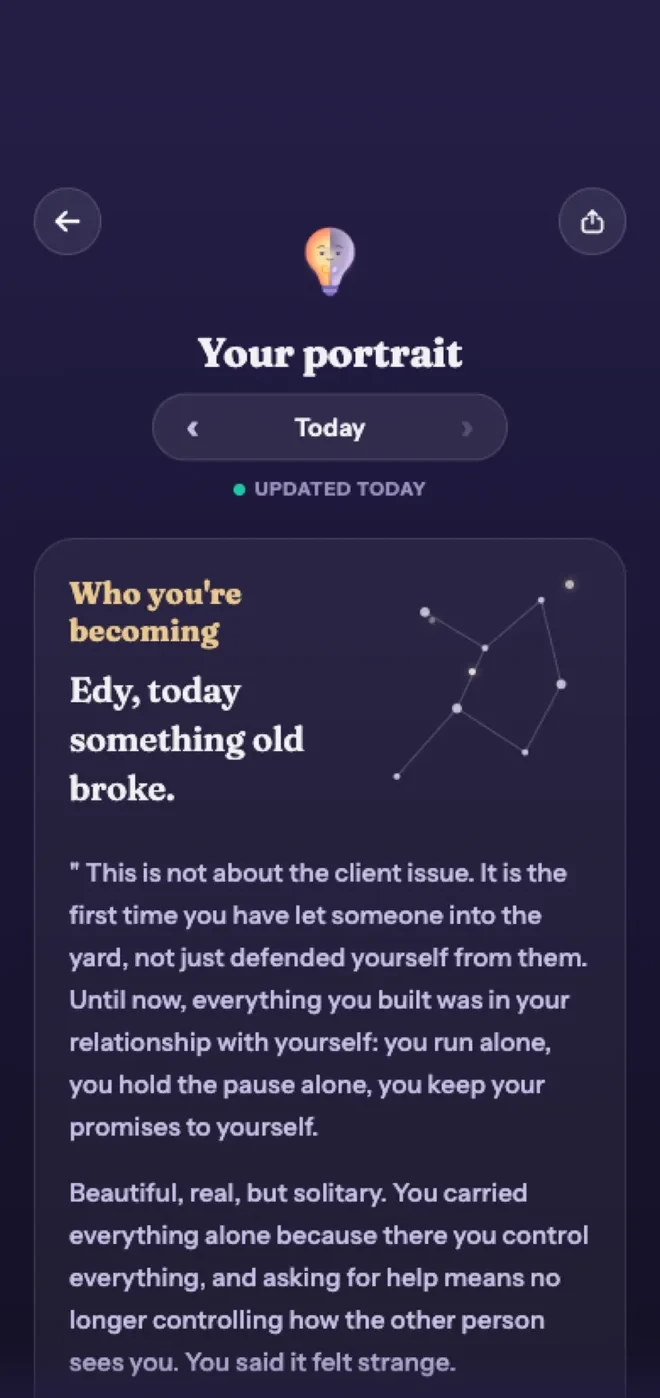
It starts with a real psychological profile, built during onboarding: how you think, what pulls you down, which patterns you carry. In the evening there is a guided reflection, a few minutes to put the day in order. From everything you write, Kibo rewrites your portrait daily, a page called Who you are becoming, which evolves as you do.
In the morning you get an insight and one concrete action calibrated to where you are, not a generic motivational quote. And the chat knows all of this context: you never re-explain your life, because it already knows you.
- A psychological profile built from onboarding, not generic assistant memory
- A guided evening reflection that feeds your portrait and your insights
- The Who you are becoming portrait, rewritten daily from what you write
- An insight plus one concrete action every morning
- Crisis detection that routes you to real help, not just general safety filters
- Guest mode and encrypted data, because this is the most sensitive data you have
ChatGPT responds to whatever you type, and that is all. Kibo keeps a living psychological profile, tracks your patterns over time and gives you direction every single day.
When ChatGPT is still fine, and when Kibo makes sense
ChatGPT remains a reasonable choice if you want to vent occasionally, understand a psychological concept, or get another perspective on a one-off situation. For that, it is free, fast and good enough.
Kibo makes sense when you want more than isolated conversations: when you want something that tracks your patterns over time, keeps you on a daily reflection practice, and gives you direction instead of just company. In other words, when the goal is no longer to feel heard but to actually change.
You can try it with zero commitment: you start in guest mode, without an account, and the free version stays free. Kibo Pro, for unlimited chat and the full portrait, is an optional subscription.
What no AI will give you
Honesty to the end: not ChatGPT, not Kibo, not any AI replaces a human therapist. Diagnosis, treatment of mental health conditions and a real therapeutic relationship remain the work of a professional, and for serious struggles that is where you need to go.
A good mental health AI is a layer of daily support: between sessions, before therapy is within reach, or for the everyday work of understanding yourself. It is a real addition, but an addition, not a replacement.
If you are in crisis right now, no chat is the answer. Call your local emergency number, or 988 in the US. For all the other days, pick the tool that was built for what you actually need.
If you already use an AI to understand yourself, try one that was built for nothing else.
Get KiboFrequently asked questions
Is it okay to use ChatGPT as a therapist?
For occasional venting and understanding psychological concepts, yes, it can help. But it was not built for therapy: it keeps no psychological profile, does not track patterns over time, can over-validate you, and has no crisis protocol. Treat it as a useful confidant, not a therapist.
What is better than ChatGPT for mental health?
A product built specifically for it. Kibo, for example, builds a psychological profile from onboarding, guides you through an evening reflection, rewrites your portrait daily and gives you one concrete action every morning. And for serious struggles, the best answer is still a human therapist.
Can an AI replace a human therapist?
No. No AI replaces diagnosis, treatment and the relationship with a real therapist. AI works as a daily support layer, useful between sessions or when therapy is out of reach. In a crisis, call your local emergency number or 988 in the US.
How much does Kibo cost compared to ChatGPT?
ChatGPT has a free tier, but it is a general assistant. Kibo has a free version too: daily chat with a message limit, the evening reflection and a daily step. Kibo Pro removes the limit and is an optional subscription.