AI Psychologist: What It Can and Cannot Do for You
AI psychologist sounds like a contradiction. An algorithm that listens when you are struggling? And yet millions of people already talk to an AI about anxiety, relationships and self-doubt, because it is there at 2 a.m., costs a fraction of a session, and never raises an eyebrow at anything you say.
The right question is not whether AI therapy is good or bad. It is more precise than that: what does it do well, what can it not do at all, and how do you use it without fooling yourself. That is exactly what this article covers.
One thing we will say upfront, so there is no ambiguity: an AI does not replace a human therapist and it is not for moments of crisis. It is a tool. A surprisingly useful one, if you know where it ends.
What an AI Psychologist Actually Is
An AI psychologist is an app built on a language model trained on concepts from psychology: cognitive behavioral therapy, thinking patterns, emotional regulation. You write what you feel, it asks questions, helps you see the situation more clearly, and suggests concrete next steps.
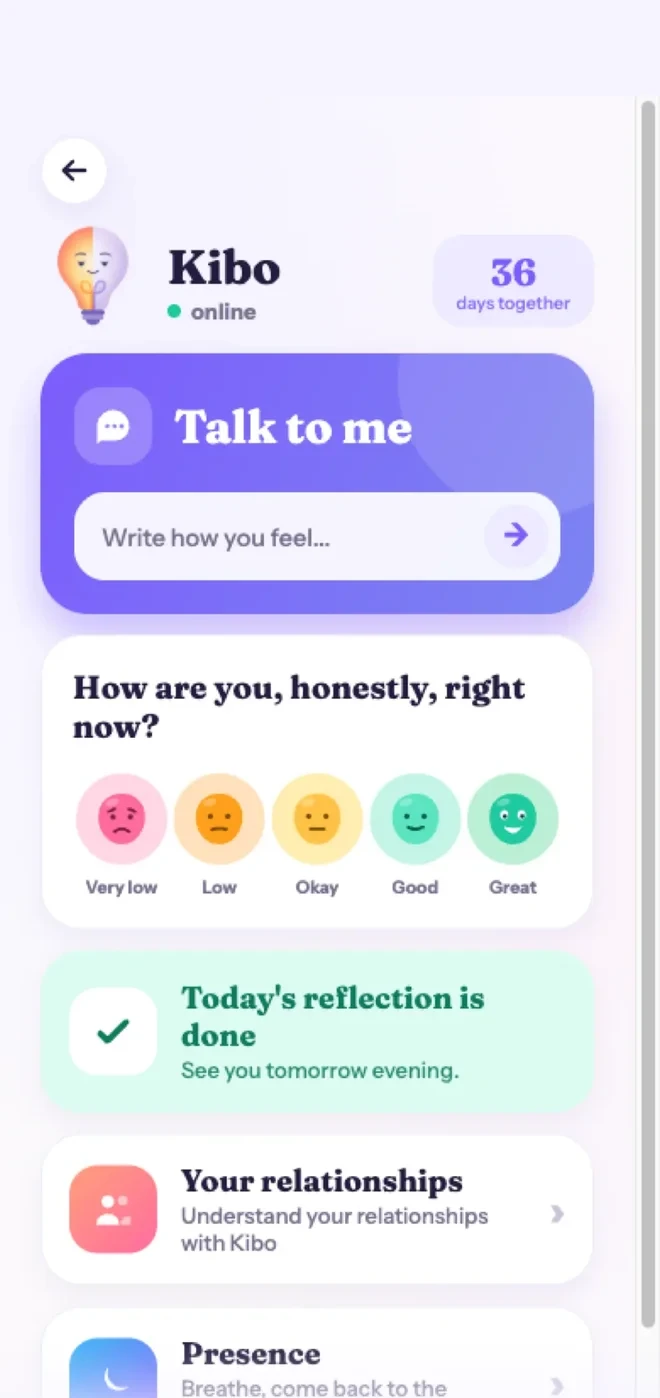
The difference from a generic chatbot is context. A general-purpose AI answers anything, but treats you like a stranger in every conversation. A good AI psychologist builds a picture of who you are and uses it. Kibo, for example, starts with a psychological profile built during onboarding: how you react to stress, what patterns you carry, what you want to change. Every conversation after that starts from there, not from zero.
So we are not talking about a robot reciting breathing quotes. We are talking about a system that remembers who you are and what you said, and connects the dots over time.
What an AI Psychologist Does Well
There are a few things an AI is honestly better at than any other option you have available on a daily basis.
The first is availability. Hard thoughts do not arrive on schedule, Tuesday at 5 p.m. They come on Sunday night, before a meeting that scares you, at 3 a.m. when you cannot sleep. An AI is there in every one of those moments. You open the app, you write, you get a response.
The second is memory. A good friend forgets what you told them three weeks ago. An AI does not. When you mention that you said yes to something you did not want to do, again, it can show you it is the fourth time this month, and that every time it involved the same person. Seeing that pattern in plain words is worth more than ten pieces of advice.
The third is the absence of judgment. There is no shame in front of an algorithm. The things you would never tell anyone, the jealousy, the envy, the thoughts you are embarrassed by, you can write them down without managing someone else's reaction. Many people get to the core of the problem faster this way.
And the fourth is cost. Traditional therapy runs somewhere between 100 and 250 dollars per session in most places. An AI psychologist like Kibo is free to use, and Kibo Pro costs far less per month than a single session. It is not the same service, and you should never confuse the two, but for daily support the difference in access is enormous.
- Available anytime, including 3 a.m.
- Remembers your conversations and spots patterns over time
- Zero judgment, you can say anything
- Free to use
Hard thoughts do not book appointments. They show up at 3 a.m.
What an AI Psychologist Cannot Do
This is the part AI therapy apps rarely say out loud. We will.
An AI does not diagnose. It cannot and should not tell you that you have depression, ADHD or an anxiety disorder. A diagnosis requires a human clinician, evaluation over time, and context a chat simply does not have. If you suspect something clinical is going on, the path leads to a psychologist or psychiatrist, not to an app.
An AI is not for crisis. If you are having thoughts of harming yourself, no algorithm is the answer. Call your local emergency line, or 988 in the US, the Suicide and Crisis Lifeline, available around the clock. Any serious app will tell you the same thing if it detects you are at a critical point, because that is the only correct answer.
An AI does not prescribe or adjust medication. Any question about antidepressants, anxiety medication or dosage belongs strictly with a psychiatrist.
And perhaps the most subtle one: an AI does not give you the therapeutic relationship. A real part of what heals in therapy comes from the bond with a human who sees you, week after week, and who challenges you exactly when you want to run. The courage to be vulnerable in front of another person cannot be trained in front of a screen. That remains irreplaceable.
An AI does not diagnose, does not prescribe medication, and is not for crisis. In a crisis call your local emergency line or 988 in the US; for diagnosis and treatment, see a human professional.
What a Day with Kibo Looks Like
To keep this out of the abstract, here is what a day with an AI psychologist that knows you actually looks like.
In the morning you get a short insight plus one action. Not a platitude, but something tied to what it has seen in you: if your pattern is saying yes on reflex, the action of the day might be to delay one answer by an hour before agreeing to anything. Small, concrete, made for you.
During the day, the chat is open whenever you need it. A tense situation at work, a message that threw you off, you write it down in the moment, while it is fresh, instead of reconstructing it from memory a week later.
In the evening comes the reflection: a few questions about how the day went. Two minutes, but this is where the raw material accumulates, the material the AI learns from about who you really are, not who you think you are.
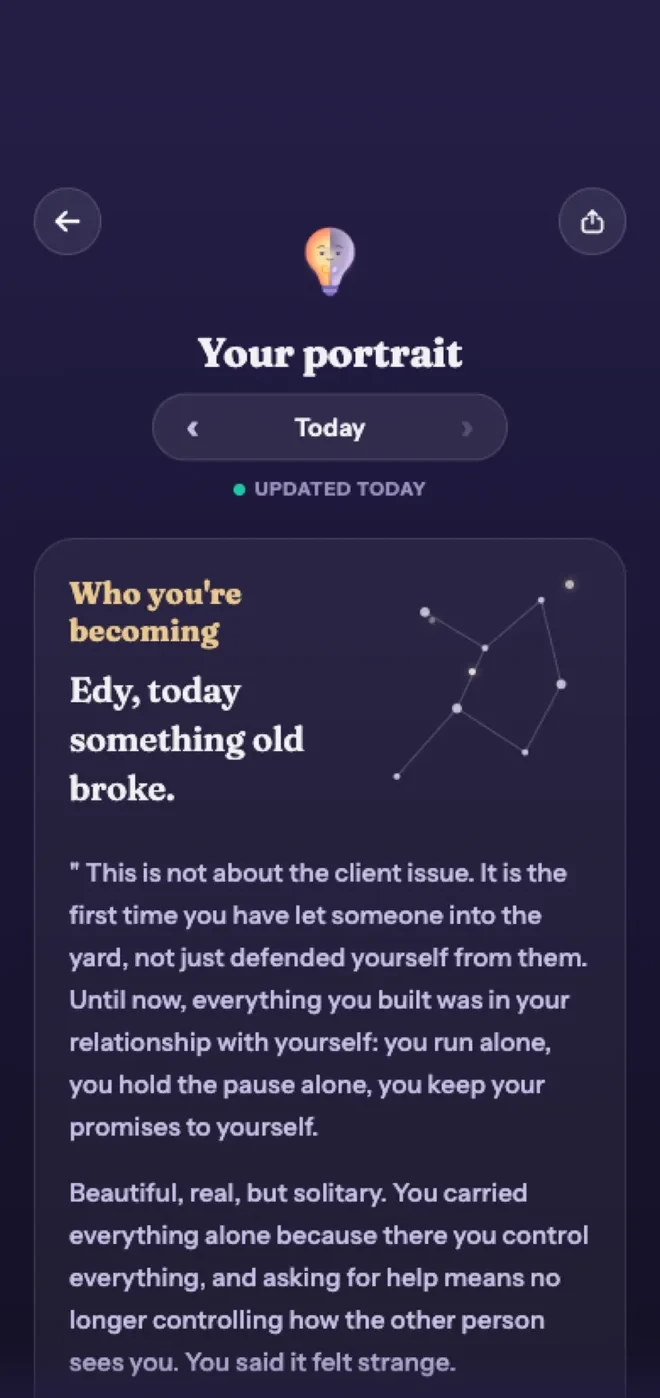
And then the part we love most: the portrait. Kibo writes a portrait of you called Who You're Becoming, and it rewrites itself daily from what you share. It is not a score and not a badge. It is a mirror made of words that changes as you change. Rereading yourself after a month is an experience few things can match.
Who It Is For, and Who It Is Not For
An AI psychologist fits if you are functional but wrestling with something: everyday anxiety, boundaries you never set, rumination, a pattern you keep repeating in relationships. If you want to understand yourself better and work on it a little but consistently, it is an excellent tool. Same if you want to try the idea of psychological support without committing to therapy, or if four sessions a month simply is not in your budget right now.
It is not a fit if you are going through an acute crisis, if you have a diagnosed condition that requires treatment, or if your main need is human connection. An AI that answers perfectly does not fix loneliness, and it can even deepen it if you use it as a substitute for people.
If you are a parent wondering about your teenager: apps like this have age limits for a reason. A teen struggling with something serious needs an adult and a professional, not a phone.
AI Therapy as a Supplement, Not a Replacement
The smartest use we have seen is not AI instead of therapy. It is AI between sessions.
Traditional therapy has a structural problem: one hour a week means 167 hours where you are on your own. Those are exactly the hours where the situations you will discuss in session happen, and by the time you get there, half the details are gone. An AI psychologist fills precisely that gap: you log reactions as they happen, you see the week's patterns, you arrive at your session with concrete material instead of vague impressions.
Many therapists assign homework between sessions precisely because change happens in daily life, not in the office. The evening reflection and morning action work, at their core, on the same mechanism, just sustained and personalized automatically.
And if you are not in therapy and do not feel the need, an AI is still a solid form of mental hygiene. The way you move your body so you never need physical therapy, you can observe your mind and get to know yourself before anything requires intervention.
A word on trust, because we are talking about the most sensitive data you have. In Kibo, conversations are encrypted, there is a guest mode where you try everything without creating an account, and your data is never sold to anyone. Any mental health app that does not state these things clearly does not deserve your thoughts.
Change does not happen in the office. It happens in the other 167 hours.
Want to see what an AI psychologist that actually remembers you feels like? Get Kibo, it is free.
Get KiboFrequently asked questions
Can an AI replace a psychologist?
No. An AI does not diagnose, does not treat disorders, and does not offer the human relationship that therapy is built on. What it can do is provide real daily support: spotting your patterns, helping you put feelings into words, and keeping you consistent between sessions or before you ever need them.
Is it safe to talk to an AI about your problems?
It depends on the app, so check before you share: encrypted data, a clear privacy policy, the option to delete everything. Kibo encrypts conversations and has a guest mode where you use the app without an account. Simple rule: if an app does not clearly state what it does with your data, do not give it your data.
How much does an AI psychologist cost compared to therapy?
A therapy session typically costs between 100 and 250 dollars in the US, often less elsewhere. Kibo is free to use, and Kibo Pro costs far less than a single session. They are different services, not competitors: one is treatment, the other is daily support.
What should I do in a crisis if I have no one to talk to?
Do not turn to an AI. In a crisis, call your local emergency line, or 988 in the US, the Suicide and Crisis Lifeline, free and available 24/7. An AI psychologist is for the daily work you do on yourself, not for moments when your safety is at risk.